


Dialogue tags are an essential part of storytelling, helping readers understand who is speaking and how a conversation unfolds. Whether you are writing a short story, a novel, a screenplay, or a creative writing blog post, learning to use dialogue tags correctly can make your writing clearer, smoother, and more engaging.
A well-placed dialogue tag identifies the speaker without distracting readers from the conversation. Simple words like said and asked often work best, while carefully chosen alternatives can add emotion, reveal a character’s personality, or set the scene’s atmosphere.
In this guide, you will learn what dialogue tags are, how they work, which types writers commonly use, and how to avoid mistakes that weaken dialogue. Practical examples will also help you understand how to use dialogue tags naturally in your own writing.
What Are Dialogue Tags?
Dialogue tags are words or short phrases that identify the person speaking in a piece of writing. They usually appear before, after, or occasionally in the middle of a character’s spoken words.
For example:
Maria said, “I will meet you at the library tomorrow.”
In this sentence, “Maria said” is the dialogue tag. It tells the reader who is speaking, while the quotation marks indicate the character’s exact words.
Dialogue tags are especially useful when a scene includes two or more characters. Without them, readers may struggle to identify the speaker or understand how the conversation progresses.
Consider another example:
“Have you finished the assignment?” Daniel asked.
The phrase “Daniel asked” identifies the speaker and makes it clear that the sentence is a question.
Dialogue tags are not limited to fiction. They can also appear in interviews, reported conversations, educational examples, and other forms of writing that reproduce spoken words.
Why Are Dialogue Tags Important?
Dialogue tags perform several useful functions in writing. They help maintain clarity, control the flow of a conversation, and sometimes communicate a character’s emotional state.
1. They Identify the Speaker
The most important purpose of a dialogue tag is to show who is talking. This becomes particularly important when several characters participate in the same conversation.
For example:
“We should leave now,” Olivia said.
The tag immediately identifies Olivia as the speaker, preventing confusion about whose words the reader is seeing.
2. They Improve Readability
A conversation without clear speaker identification can become difficult to follow. Dialogue tags help readers move between different voices without repeatedly stopping to work out who said what.
Writers do not need to attach a tag to every sentence, however. When two characters exchange short lines in an established conversation, readers can often follow the speakers without additional explanation.
3. They Help Establish Tone
Some dialogue tags communicate how a character delivers a line.
For example:
“I thought you had forgotten,” James whispered.
The word “whispered” suggests a quiet delivery and may create a sense of secrecy or intimacy.
Similarly, a tag such as “shouted” indicates a raised voice. However, the surrounding dialogue and the character’s actions should also help establish the intended emotion.
4. They Support the Pace of a Scene
Short, simple tags generally keep dialogue moving quickly. Longer descriptions or frequent dramatic tags can slow a conversation.
Compare these sentences:
“Come with me,” Alex said.
“Come with me,” Alex said hesitantly, glancing toward the dark hallway.
The first sentence moves quickly. The second adds hesitation and atmosphere, making it more appropriate for a scene where uncertainty matters.
The best choice depends on what the scene needs.
Common Types of Dialogue Tags
Writers can choose from many dialogue tags, but the right option depends on the scene, the character, and what the words mean.
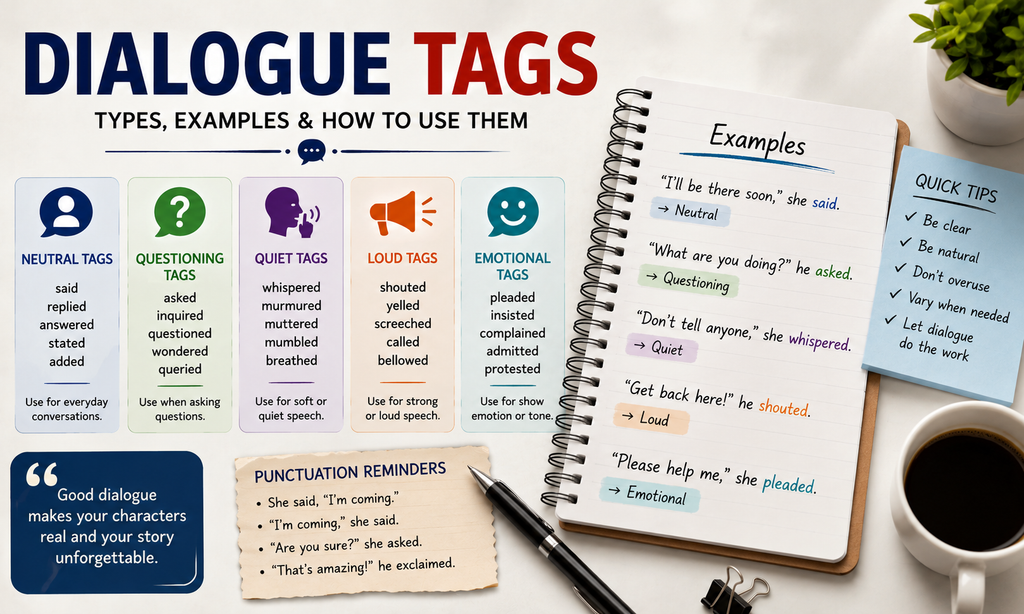
1. Neutral Dialogue Tags
Neutral tags identify the speaker without adding a strong emotional interpretation. They are useful in everyday conversations, descriptive storytelling, and scenes where the dialogue itself carries the meaning.
Common neutral dialogue tags include:
- Said
- Replied
- Responded
- Answered
- Added
- Continued
- Explained
- Stated
- Noted
- Remarked
Example:
“The meeting starts at nine,” Sarah said.
“I will be there early,” Michael replied.
These tags keep the focus on the conversation rather than the mechanics of the writing.
2. Questioning Dialogue Tags
Use questioning tags when characters ask questions or seek information. The most common choice is asked, although other options may suit specific contexts.
Examples include:
- Asked
- Inquired
- Questioned
- Wondered
- Queried
Example:
“Have you seen my notebook?” Emma asked.
“Why did you leave so early?” Daniel questioned.
“Asked” is usually the most natural option for ordinary questions. Words such as “inquired” may sound more formal, while “questioned” can suggest doubt or scrutiny.
3. Quiet Dialogue Tags
Quiet dialogue tags show a character speaking softly or trying not to be overheard. They work especially well in emotional, suspenseful, or intimate scenes.
Common examples include:
- Whispered
- Murmured
- Muttered
- Mumbled
- Breathed
Example:
“Someone is outside,” Lily whispered.
“I am not sure this is a good idea,” he murmured.
These words are not interchangeable in every situation. Whispering suggests a very quiet voice, while mumbling may imply unclear speech. Choose the term that accurately describes the character’s delivery.
4. Loud Dialogue Tags
Loud dialogue tags help communicate volume, urgency, or the need to be heard across a distance.
Examples include:
- Shouted
- Yelled
- Screamed
- Called
- Bellowed
- Roared
Example:
“Watch out!” the coach shouted.
“Wait for me!” Noah called.
These tags can make an action scene more vivid, but using them in every exchange may make a story feel unnecessarily dramatic. A simple tag or a strong line of dialogue may be enough.
5. Emotional Dialogue Tags
Some dialogue tags suggest an emotional quality in a character’s speech. They can help distinguish anger, frustration, sadness, excitement, or uncertainty.
Examples include:
- Snapped
- Complained
- Pleaded
- Insisted
- Admitted
- Confessed
- Protested
- Exclaimed
Example:
“Please give me another chance,” Maya pleaded.
“I told you this would happen,” Daniel snapped.
An emotional tag should fit the meaning of the sentence. For example, “pleaded” implies a request made with urgency or desperation, whereas “snapped” suggests a sharp or irritated response.
Writers should also remember that tags like “laughed” and “sighed” sometimes describe actions that accompany speech rather than the act of speaking itself. In those cases, a separate action beat may be clearer.
Dialogue Tags vs. Action Beats: What Is the Difference?
Dialogue tags and action beats serve related purposes, but they are not the same.
A dialogue tag identifies the speaker using a speaking verb. An action beat describes something a character does before, during, or after speaking.
Dialogue tag
“I do not believe you,” Olivia said.
The tag identifies Olivia as the speaker.
Action beat
“I do not believe you.” Olivia folded her arms.
The action provides body language and hints at her attitude.
Action beats can make a scene more engaging by revealing movement, reactions, and physical details while letting dialogue unfold naturally.
When Should You Use an Action Beat?
Use an action beat when a character’s behavior adds something meaningful to the scene.
For example:
“I am fine.” Marcus pushed the untouched dinner away.
The action suggests Marcus may not actually be fine, letting readers interpret the contradiction between his words and behavior.
By contrast, a sentence such as “Marcus said he was fine” communicates the information directly without the same visual detail.
A strong action beat can also identify the speaker without repeating a dialogue tag, particularly when the conversation already makes the participants clear.
Can Dialogue Tags and Action Beats Be Used Together?
Yes. Writers can combine them when both attribution and physical action are useful.
For example:
“I knew you would come,” Elena said, opening the door.
Here, “Elena said” identifies the speaker, while “opening the door” adds movement to the scene.
However, avoid attaching an action to a dialogue tag as if the action were a speech verb.
Incorrect:
“I am leaving,” he said with a smile.
Better:
“I am leaving,” he said with a smile.
Or:
“I am leaving.” He smiled and reached for his coat.
The distinction matters because smiling is an action, not a way of producing spoken words in the grammatical sense.
How to Punctuate Dialogue Tags Correctly
Correct punctuation makes dialogue easier to read and helps distinguish a character’s words from the surrounding narration.
Dialogue Tags Before the Dialogue
When the tag appears first, place a comma after it and before the opening quotation mark.
Example:
Rachel said, “I will call you tonight.”
The comma connects the introductory dialogue tag to the spoken sentence.
Dialogue Tags After the Dialogue
When a dialogue tag follows a statement, use a comma inside the closing quotation mark in standard American English.
Example:
“I will call you tonight,” Rachel said.
The tag normally begins with a lowercase letter because it continues the same sentence.
Dialogue Tags After Questions
When the spoken words end with a question mark, retain the question mark and begin the tag with a lowercase letter.
Example:
“Are you coming with us?” Rachel asked.
Do not add another comma after the question mark.
Dialogue Tags After Exclamations
The same principle applies when dialogue ends with an exclamation mark.
Example:
“That is wonderful!” Rachel exclaimed.
The exclamation mark remains inside the quotation marks, and the following dialogue tag begins with a lowercase letter.
Dialogue Tags Interrupting a Sentence
A dialogue tag can interrupt a character’s sentence when the speaker pauses, or the writer wants to create a particular rhythm.
Example:
“If we leave now,” Rachel said, “we can reach the station before dark.”
Because the same sentence continues after the tag, commas separate the dialogue from the interruption.
If the character finishes one sentence and begins another, the punctuation changes.
“I have made my decision,” Rachel said. “I am not changing my mind.”
In this example, the first sentence ends before the second begins.
How to Use Dialogue Tags Effectively
Understanding the rules is only the first step. Effective dialogue tags also require judgment, consistency, and attention to the reader’s experience.
Prefer “Said” and “Asked” When They Are Enough
The word “said” is often the strongest choice because it identifies the speaker without distracting from the dialogue. Readers are familiar with it and can usually process it without interrupting the story’s flow.
For example:
“I left the keys on the table,” James said.
There is no need to replace “said” with an unusual synonym to make the sentence appear more sophisticated.
Descriptive tags are useful when they communicate information that would otherwise be unclear. The goal is not to eliminate variety but to make every word earn its place.
Avoid Overusing Dialogue Tags
Repeated tags can make conversations feel mechanical.
Instead of identifying every line, establish the speakers and use tags only when readers need help following the exchange.
For example:
“Did you lock the door?” Anna asked.
“Yes,” Peter said.
“And the windows?”
“All of them.”
Anna picked up her bag. “Then we can go.”
The dialogue remains clear because it has only two speakers and follows a logical pattern.
If the scene involved several people speaking at once, you might need additional tags.
Choose Tags That Match the Meaning
A dialogue tag should accurately describe the way the words are spoken.
For instance, “whispered” works for quiet speech, while “shouted” suits a raised voice. A character who says something calmly should not be described as screaming unless the scene provides a reason for that contrast.
When the emotion is already obvious, an ordinary tag may work better than a dramatic alternative.
Use Dialogue Tags to Support Characterization
A character’s speaking style can reveal personality, confidence, age, relationships, or social position. Tags can support those details, although the actual words and behavior usually do more of the work.
A nervous character might stammer during a difficult conversation. A confident character might answer directly. A frustrated character might interrupt or speak sharply.
The tag should reinforce these qualities rather than substitute for believable dialogue.
Read Dialogue Aloud
Reading a conversation aloud is a practical way to identify awkward phrasing, unnecessary tags, and unnatural speech patterns.
If every line seems to require an elaborate verb, the dialogue may be trying too hard. If you cannot tell who is speaking, additional attribution or a carefully placed action beat may be necessary.
The best revision usually makes the conversation easier to follow without drawing attention to the editing.
Common Dialogue Tag Mistakes to Avoid
Even a well-written story can become harder to read when dialogue tags are used incorrectly. These are some of the most common problems to watch for.
Mistake
Better approach
Using elaborate tags in every sentence Prefer simple, natural speech verbs.
Using a comma before an action beat End the dialogue with a period when the action begins a new sentence.
Repeating the speaker’s name too often Omit unnecessary tags when the speaker is obvious.
Choosing a tag that contradicts the dialogue Match the tag to the character’s actual delivery.
Using a tag for every line Add tags only when they improve clarity.
Confusing thoughts with spoken words Distinguish internal thoughts from audible dialogue.
Mistake 1: Treating Actions as Speech
Incorrect:
“I am ready,” she nodded.
Correct:
“I am ready.” She nodded.
Alternatively:
“I am ready,” she said, nodding.
The corrected versions distinguish the act of speaking from the physical action.
Mistake 2: Using Too Many Unusual Verbs
Consider this example:
“Come here,” he commanded.
“Why?” she demanded.
“Because I said so,” he thundered.
Every tag attempts to make the conversation dramatic. Unless the scene genuinely calls for this intensity, simpler wording will often be more effective.
A more natural version might be:
“Come here,” he said.
“Why?” she asked.
“Because I said so.”
The dialogue itself creates the tension, without requiring a different dramatic tag in every sentence.
Mistake 3: Forgetting Paragraph Breaks
In conventional prose, begin a new paragraph whenever the speaker changes.
For example:
“Have you seen my phone?” Olivia asked.
“It is on the kitchen counter,” Daniel replied.
“Thanks. I have been looking everywhere.”
Paragraph breaks make the conversation easier to follow. They also help readers identify which lines belong to which characters.
Dialogue Tags in Different Types of Writing
Dialogue tags are common in fiction, but their use varies by format and purpose.
Fiction and Novels
In novels and short stories, dialogue tags help readers follow character interactions. Writers may combine them with body language, setting, and internal thoughts to create a complete scene.
Screenplays
Screenplays generally identify speakers using character names placed above their dialogue. Traditional screenplay formatting does not rely on dialogue tags as prose fiction does, though brief parenthetical directions may clarify delivery when needed.
Interviews and Articles
Journalists may use tags such as “said,” “explained,” and “added” to attribute statements to interviewees. These attributions help distinguish the interviewee’s words from the journalist’s narration.
Accuracy is especially important in journalism: a tag should not misrepresent what a source said or imply an emotion that the evidence does not support.
Educational and Academic Writing
Dialogue tags appear in language-learning examples, literary analysis, and grammar explanations. They show how spoken language appears in writing and how punctuation works.
The terminology may vary slightly by context, but the central function remains the same: identifying the speaker.
Conclusion
Dialogue tags are small but important elements of effective writing. They identify speakers, clarify conversations, establish the tone of spoken words, and help readers move smoothly through a story.
The most useful dialogue tags are often the simplest. Words like “said,” “asked,” and “replied” usually do enough, while more descriptive choices can add meaning when used carefully. Action beats offer another way to show a character’s behavior without relying on a speech tag for every line.
To use dialogue tags effectively, learn the punctuation rules, avoid unnecessary repetition, choose accurate speech verbs, and make sure readers can always follow who is speaking. With practice, these techniques will help you create clearer, more natural, and more engaging dialogue.
May you also like: Drop Waist Wedding Dress
Frequently Asked Questions About Dialogue Tags
1. What are dialogue tags?
Dialogue tags are words or phrases that identify who is speaking in a written conversation. Examples include “she said,” “he asked,” and “they replied.”
2. What are the most common dialogue tags?
The most common dialogue tags include “said,” “asked,” “replied,” “answered,” “whispered,” “shouted,” and “muttered.” “Said” and “asked” are especially useful for everyday dialogue.
3. Can dialogue tags appear before or after dialogue?
Yes. They can appear before spoken words, after them, or between two parts of a sentence. Correct punctuation depends on the tag’s placement and whether the dialogue continues.
4. What is the difference between a dialogue tag and an action beat?
A dialogue tag identifies the speaker, usually through a speech verb. An action beat describes a physical action, expression, or movement associated with the conversation.
For example, “she said” is a dialogue tag, while “she crossed her arms” is an action beat.
5. Do writers need dialogue tags in every sentence?
No. Writers can omit tags when the speaker is already clear. Fewer tags can make conversations feel more natural, as long as readers don’t get confused about who is speaking.
6. Should dialogue tags always use the word “said”?
No. “Said” is a reliable default, but other tags can be useful when they accurately communicate the way someone speaks. The important thing is to choose natural, precise wording rather than forcing variety.
7. How do you punctuate dialogue tags correctly?
When a tag follows a statement, use a comma inside the closing quotation mark, as in “I agree,” she said. When a tag comes before the dialogue, place a comma after the tag, as in She said, “I agree.” Questions and exclamations retain their question marks or exclamation marks before the tag.



Pingback: Kelsy Ully: 9 Powerful Facts About Her Life and Career